What's hiding in plain sight?
What’s Hiding in Plain Sight?
In 1854, Florence Nightingale arrived at the Barrack Hospital in Scutari with a notepad, a lamp, and a reasoned suspicion that something important was being missed. British soldiers were dying in extraordinary numbers. The prevailing explanation was straightforward: men were dying from battle wounds. That conclusion was visible, logical, and accepted without question by everyone in authority.
Nightingale collected data instead of accepting the narrative. What she found was that most deaths were not from combat injuries at all. They were from preventable conditions: cholera, typhus, and dysentery, spreading through overcrowded wards with inadequate ventilation, contaminated water, and poor sanitation. The real cause of mortality was hiding inside the institution itself, unnoticed because everyone had adapted to it.
She visualised the findings in what is now her famous polar area diagram, a graphic representation of monthly death rates broken down by cause. Once the data was visible, it could not be argued away. Systems changed, conditions improved, and the death rate at Scutari fell from roughly 42% to around 2% within six months.¹
The lesson is not primarily about nursing or data visualisation. It is about what happens when you finally shine a light into the corners and take an honest look at how much dust has been quietly collecting there.

Most practice owners are not oblivious to inefficiency. They feel it. The team feels it. There is the appointment that consistently runs late, the information that somehow never reaches the right person, the supply run that takes twice as long as it should. Over time, it becomes the background noise of a practice in motion. It starts to feel like normal.
But normal is not the same as optimal. Before you can optimise how your practice runs, you first have to name what it is actually running on. This includes the work that should not exist in the first place. And you cannot fix what you haven’t named.
The 8 Wastes: A framework for the load you’re carrying in your business
Lean methodology, developed at Toyota and now well-established in healthcare operations, provides a practical taxonomy for practice waste. The eight categories, known by the acronym DOWNTIME, describe the ways capacity, time, and resources are lost in any service environment.
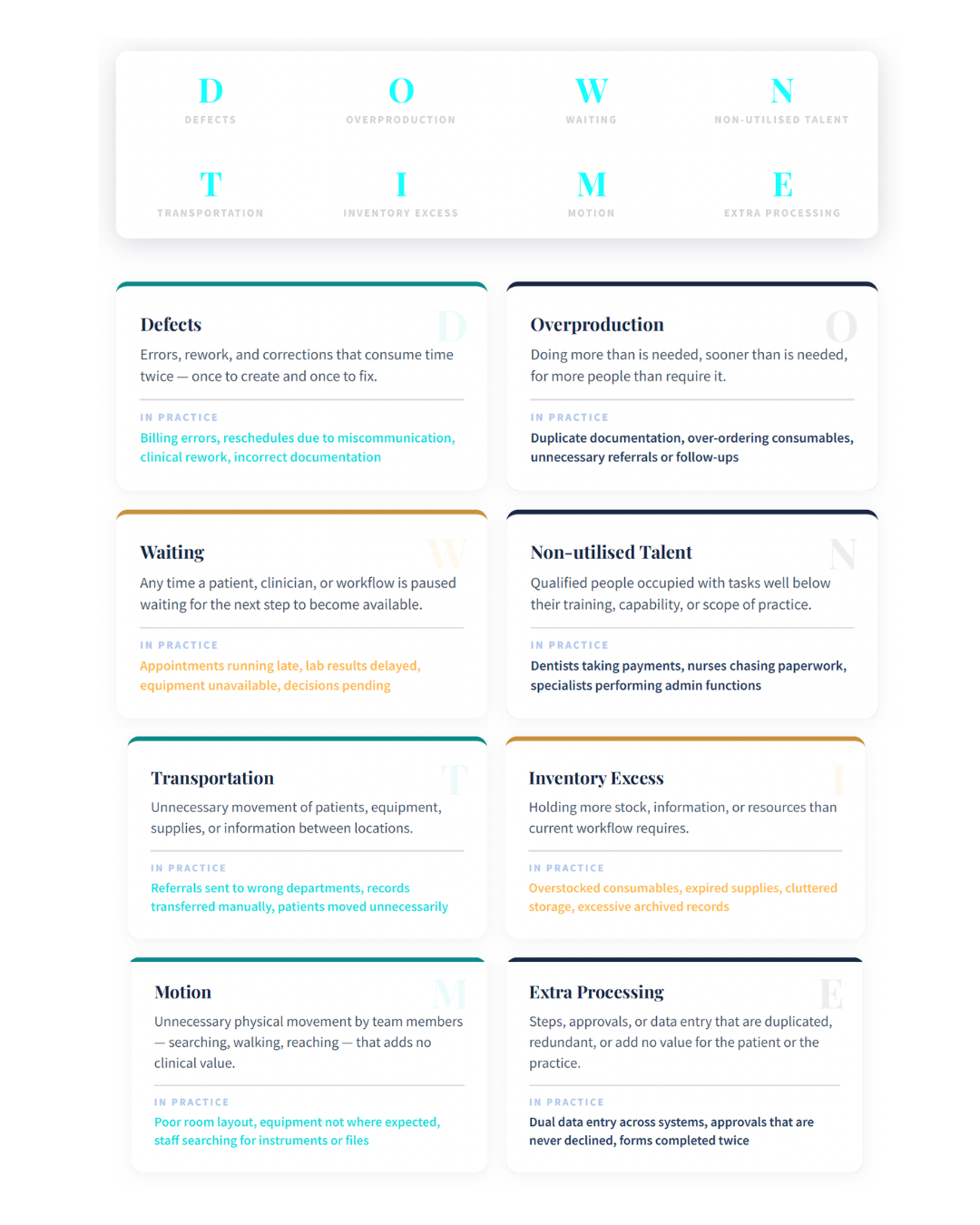
In clinical settings, these wastes show up in predictable ways. Defects appear as billing errors, reschedules, and clinical rework. Overproduction surfaces as duplicate documentation and over-ordering. Waiting is the gap between what is booked and what actually runs on time. Non-utilised talent is the most quietly expensive category: qualified team members occupied with tasks well below their scope while the work that genuinely requires their skills sits in a queue.
Transportation waste in a clinical setting includes unnecessary patient movement and the physical travel of information between systems that do not communicate with each other. Inventory waste lives in the storeroom which may be overstocked, expired, or simply lost. Motion waste is the daily accumulation of steps taken to find things that are not where they should be. And extra processing is the form completed twice, the approval required from someone who approves it automatically every single time.
McKinsey’s 2023 research on healthcare workforce capacity found that up to 30% of clinical tasks could be automated or delegated to appropriately skilled team members, time currently consumed by structural inefficiencies and poorly designed workflows rather than work that genuinely requires a clinician’s expertise.³ Gallup’s meta-analysis across 112,312 business units confirms the other side of that equation: role clarity, specifically knowing what is expected at work, is the single most fundamental driver of employee productivity, and it is the area where organisations most consistently fall short.⁴
PwC Australia’s Perform methodology, deployed across healthcare organisations internationally, reports that addressing operational waste typically releases 15-25% in capacity improvements without adding headcount or floor space.⁵ In a practice already running close to capacity, that often represents the difference between being sustainable and being stretched.
Appraise before you act
The temptation, when you recognise waste, is to fix it immediately. The more reliable move is to map it first. When you appraise your business for where DOWNTIME waste is occurring, the starting question is simple but revealing: what actually takes time in a standard day? Not what should take time. What does.
The gap between those two answers is where the waste lives. Naming it accurately is the only reliable basis for building something better.
Guesswork does not equal success work.
The following few questions are worth sitting with this week:
Which of the eight wastes would your team nominate as the biggest time drain in your practice right now?
Are there tasks being performed regularly by team members that fall significantly below their qualifications or scope?
If you could recover 15% of your team’s productive time this month, what would you do with it?
I’d love to hear your thoughts.
Yours in healthcare excellence,